
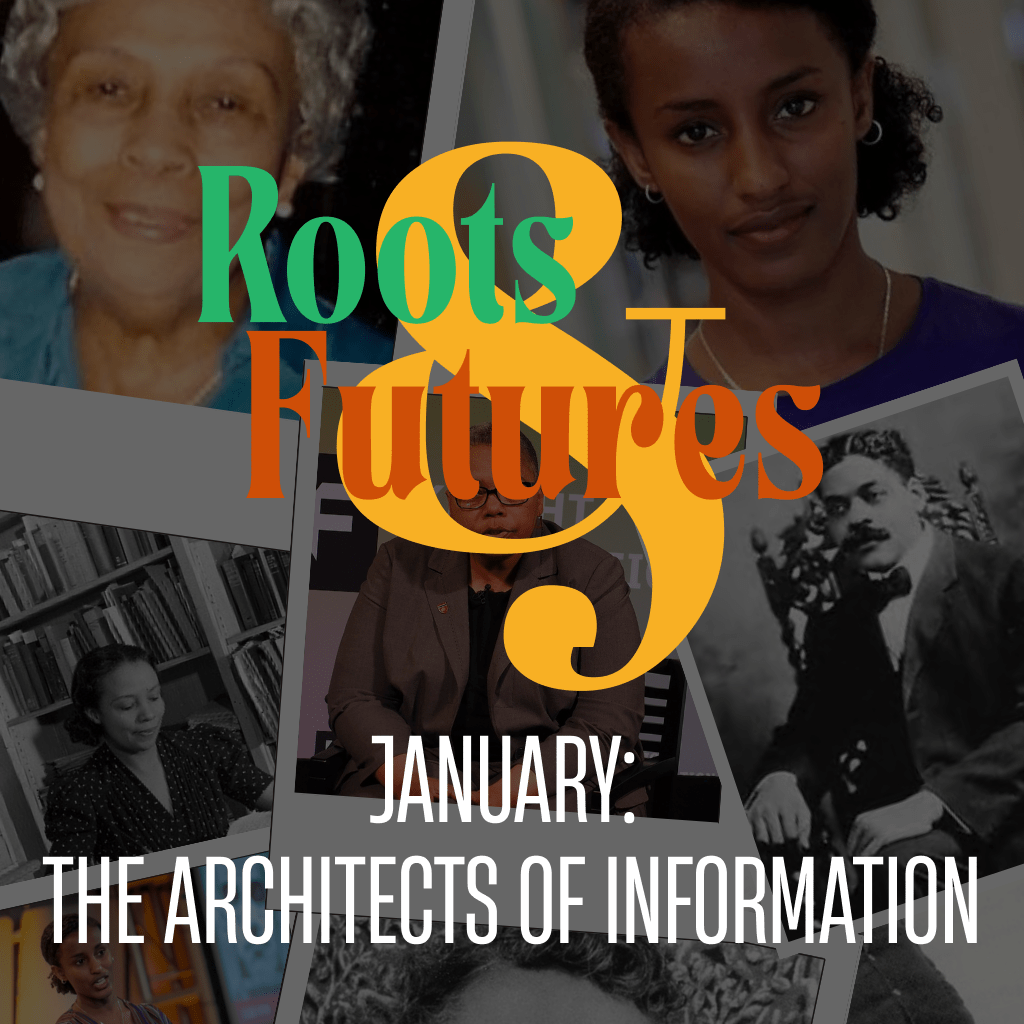
The inaugural month of the Roots & Futures series, “The Architects of Information,” served as a foundational exploration into the invisible structures that govern our understanding of human history. We moved through a century of progress, demonstrating that while the tools of information have evolved from ink-stained library cards to complex neural networks, the central mission remains the same: the defense of truth against the tide of erasure.
The theme focused on the “Classification of Brilliance” — a direct challenge to the historical tendency of mainstream institutions to treat Black life as a monolith of tragedy. In the early 20th century, figures like Dorothy Porter Wesley and Arturo Schomburg realized that the archives of the world were being used as weapons of exclusion. Schomburg, the “History Hunter,” traveled the globe to rescue the physical artifacts of the African Diaspora. Simultaneously, at Howard University, Dorothy Porter Wesley staged a silent revolution within the library stacks, subverting the Dewey Decimal System to move Black authors out of the “Slavery” and “Negro Problem” sections and into their rightful academic fields.
As the series progressed into the modern era, we witnessed the “Future” of this architectural work through the lenses of Rediet Abebe and Latanya Sweeney. Rediet Abebe, a pioneer in computer science, picked up the baton by auditing the very code that governs our lives, using mathematical modeling to ensure algorithmic fairness. Latanya Sweeney’s “data detective” work proved that in a world of Big Data, privacy is a civil right.
January taught us that information is never neutral. How we organize a database or a library dictates who is seen and who is forgotten. By bridging the gap between the historical archive and the digital lab, “The Architects of Information” proved that Black excellence has always been a calculated, engineered endeavor.